Before the Painted Crossing: How Streets Signalled a Route
Before painted crossings, routes depended on gaps, kerbs and local habits. See how street markings made crossing points easier to recognise and share.
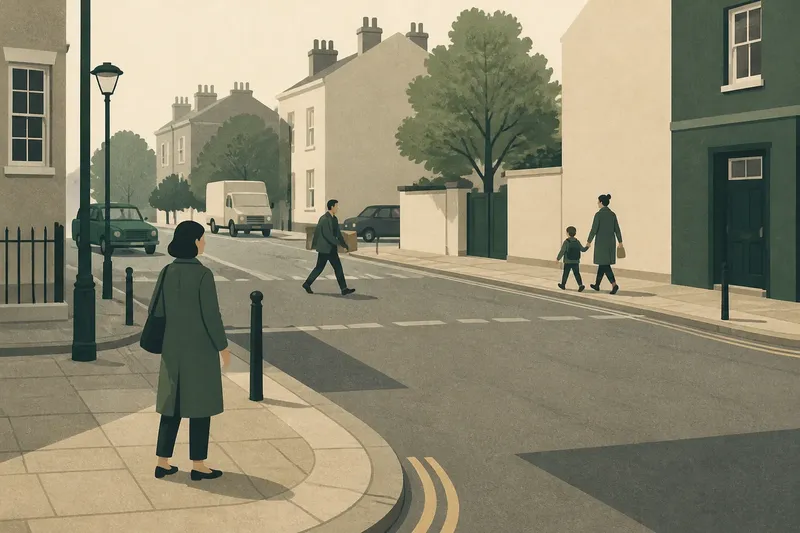
The common mistake is to imagine a street before painted crossings as a blank space where pedestrians simply waited for a gap. Before painted crossings became familiar, people read kerbs, corners, entrances and moving traffic; the cost of overlooking those cues is a false picture of how a route became legible.
This account concerns the broad shift towards marked crossings, not a single date or a uniform history. Streets and rules differed by place, and paint did not invent crossing. It made selected crossing points more visible as shared routes.
Gaps offered clues
On an unmarked street, a useful crossing point might be where parked vehicles left a clear view, a wall ended, or traffic slowed near a junction. These were practical cues, but they depended on conditions at that moment. A gap showed where someone might cross; it did not, by itself, tell drivers to yield or establish a pedestrian’s priority.
Different people could take different lines across the same road. A child following an adult, a delivery worker heading for a doorway and a resident walking towards a bus stop might each choose a route that made sense to them. Their choices were not necessarily obvious to everyone else.
Kerbs shaped routes
Kerbs marked the edge between pavement and carriageway. They led people towards corners and helped define the street’s shape, but they were not crossing instructions. A person still had to choose where to step into the road and where to reach the opposite pavement.
A lowered or missing kerb could make a particular line easier to use, but it might also serve an entrance or driveway, or reflect uneven construction. Street features can suggest how people moved without proving that a crossing was deliberately designated there.
Paint added another kind of cue. Rather than marking only where the pavement ended, it identified a route across the carriageway. The crossing could be read as a place with a visible direction, not merely a convenient opening at the kerb.
Habit supplied context
People who used a street regularly learned its rhythms: where vehicles turned, which corner offered a clearer view, and when a queue blocked the pavement. That knowledge helped them interpret a route, but it was not shared equally. A visitor might not know where to look, and someone carrying shopping might have fewer ways to adjust their path.
Markings made one part of that local knowledge visible to strangers. They did not explain every traffic movement or settle every question of priority. They did make the intended crossing point easier to identify without already knowing the neighbourhood.
Paint made expectations public
A marked crossing presents a route as more than one person’s improvised choice. It tells pedestrians where a crossing is intended and alerts drivers to look for people moving there. That shared signal is useful, though it is not a promise that every driver will stop.
Markings work alongside street design, traffic rules and people’s attention. Their precise legal meaning depends on the crossing type and local rules. A painted route can make a place more legible while leaving everyone responsible for responding to what is actually happening.
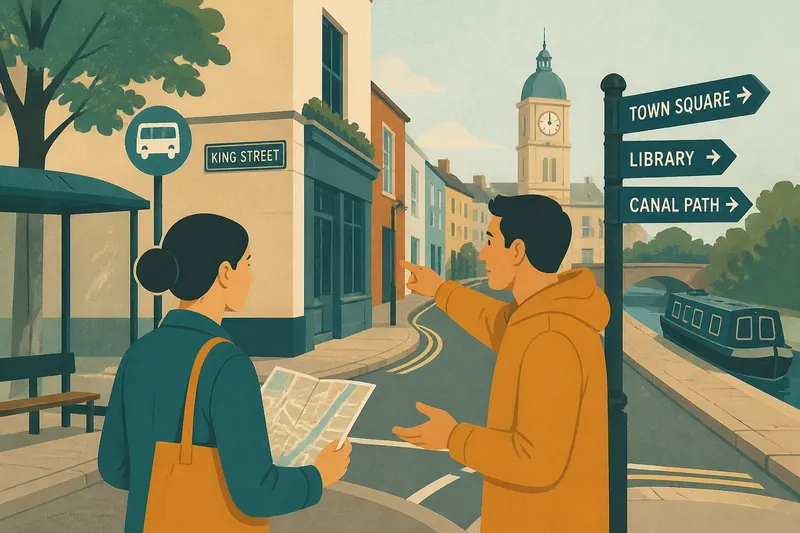
Imagine a visitor at an unfamiliar junction with a broad corner and no painted crossing. The visitor sees a local person cross near the corner, but cannot tell whether that line is customary or simply convenient. If the junction has a marked crossing, the visitor can identify the intended route before stepping off the pavement; the observable result is a clearer place to look, not certainty about approaching traffic.
Routes took visible shape
Painted lines give a crossing a direction and a visible area. They can connect the pavement on one side with a destination on the other, making it easier to see where pedestrians are likely to travel. People may gather near the marked edges rather than spread along the whole kerb, although pavement crowding can still complicate the arrangement.
To read an older street pattern, compare the kerbs, corners, entrances and routes people now take. A worn line or kerb gap may offer a clue, but its origin is rarely certain from appearance alone. It is not worth spending much effort assigning a single intention to every old mark; several ordinary uses can leave similar traces.
How crossings changed practice?
Did painted crossings create pedestrian routes?
No. People crossed streets before road markings became familiar, using corners, openings and local habits. Paint made selected routes more explicit to people who did not already know the street.
Why could informal cues mislead?
A parked vehicle, crowd or change in traffic could alter what seemed like a useful opening. A regular user might understand a familiar corner, while a visitor saw only an ambiguous gap.
Did markings remove the need for judgement?
No. A crossing marking identifies a route, but it does not make traffic conditions disappear. People still need to pay attention, and the applicable rules depend on the crossing type and local law.
Clues became convention
The shift from informal cues to marked crossings changed how a street addressed its users. A gap or familiar corner invited interpretation; painted lines presented a crossing as a shared convention. That reduced the local knowledge needed to recognise a likely route, without removing the need to notice traffic.
Before painted crossings, the street’s route signals were scattered across kerbs, corners and habits. Markings brought one crossing point into view for people approaching from either side. When reading older streets, treat those traces as evidence of possible movement, not proof of a formal designation.