The Empty Pavement Myth: What a Quiet Street Leaves Out
The empty pavement myth treats unused space as success. Learn how comfort, access and purpose reveal whether a city pavement serves its neighbours.
The most common mistake in judging a pavement is to call it successful because nobody is in the way. The empty pavement myth confuses room to pass with a place people can comfortably use; it can leave a street looking orderly while excluding anyone who would otherwise pause there.
A clear route matters. But a pavement has more than one job: it carries people through, gives them somewhere to wait, and sometimes offers a brief place to sit or talk. Whether it can do those jobs depends less on emptiness than on how the space meets ordinary needs.
Clear is not comfortable
An unobstructed stretch may be useful for walking, wheeling a buggy or moving a mobility aid. Yet it tells us little about whether a person can stop without feeling exposed, blocking others or being hurried along. A pavement can be technically passable and still offer no comfortable way to wait for a friend or catch one’s breath.
Comfort is not a decorative extra. It is part of access: people have different reasons and abilities when moving through a city, and many need to pause. A seat with arms, a low wall that is safe to perch on, or a sheltered edge can make stopping possible. Without such options, the pavement may be available only to those who can keep moving.
There is also a difference between a place that is empty because it has no reason to hold anyone and one that is briefly quiet between daily routines. A school entrance, bus stop or market street may be busy at particular moments and subdued at others. A glance at one quiet interval cannot settle what the pavement is for.
Read the edges
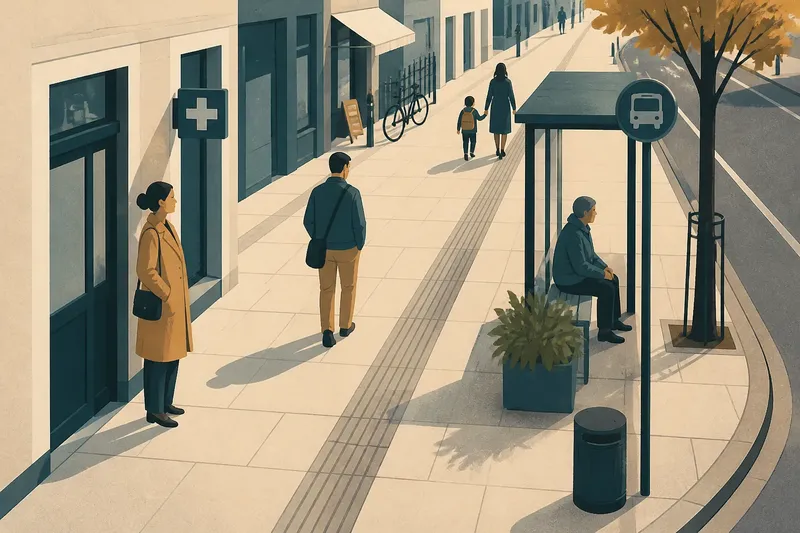
People often choose the edge of a public space rather than its centre. A shopfront, a tree pit, a low railing or the sheltered side of a building can provide a sense of support without requiring a formal seat. These details may make a pause feel less exposed. If they are absent, a broad paved area can feel strangely difficult to occupy.
Edges can also carry problems. A doorway that opens outwards, a café queue, parked bicycles or bins can narrow the route people need to pass. The useful question is not simply whether objects are present, but whether the remaining path works for those passing through while leaving any suitable place to stop.
Notice where people naturally pause and what they do there. Do they stand beneath an awning, lean against a wall, or wait beside a bus pole? Such behaviour can reveal a need the layout has not made comfortable. It does not, by itself, say what should be built: the activity may be brief, seasonal or linked to nearby services.
Purpose changes the test
Different pavements call for different expectations. A narrow street beside busy shops may chiefly need a clear walking route, with stopping space kept out of the flow. Near a library, clinic or transit stop, waiting may be an ordinary part of the street’s use. A pavement beside homes may need both a direct route and places where neighbours can pause without turning a doorway into a bottleneck.
That does not mean every stretch needs benches, planters and a programme of activity. Too much furniture can make movement harder, create awkward corners or leave people with nowhere comfortable to wait. A thoughtful assessment starts with the street’s everyday purpose and asks whether the space supports it for different users.
Imagine a pavement outside a neighbourhood clinic with a clear route but no sheltered place to wait. Someone arriving early stands close to the entrance, where people entering must pass around them. If the layout offered a suitable waiting spot beside, rather than across, the main route, the expected observable result would be a more direct path through and a less exposed pause. The point is not that every clinic needs the same arrangement; it is that apparent emptiness can conceal a conflict between passing and waiting.
Questions about pavement use?
Does an empty pavement mean the design is working?
Not on its own. It may show that the walking route is clear, but it may also indicate that there is nowhere comfortable or appropriate to stop.
How can I tell whether people want to linger?
Look for recurring, ordinary pauses: people waiting near a stop, leaning by a shopfront or gathering at an entrance. Consider what nearby places bring people to the street and whether the pause disrupts the route.
Should every pavement have seating?
No. Seating can help where people need to wait or rest, but poorly placed furniture can obstruct movement. The choice depends on the available space and the pavement’s role.
What is the difference between quiet and unused?
Quiet describes what is happening at a particular moment; unused suggests that the space does not support a purpose. A street may be quiet between busy periods while still serving residents, visitors and passers-by.
Judge the whole rhythm
To understand a pavement, consider it across the ordinary pattern of the day rather than treating one empty moment as a verdict. Notice the morning school run, the lunch-hour queue, the wait for a bus and the quieter spell later on. Each can bring different needs and different pressures on the same stretch of ground.
It is not worth trying to make every pavement look lively, or counting every person who pauses as proof of success. Activity can be noisy, fleeting or awkwardly placed; quiet can be welcome. A better question is whether people can pass, wait or rest without one use needlessly cancelling another.
The empty pavement myth is useful to challenge because it turns absence into an easy score. A clear route remains valuable, but the main search phrase—empty pavement myth—points to a broader judgement: space works when its emptiness is a choice, not the only condition it permits. Look at who can comfortably use the street, where they can do so, and what the pavement makes unnecessarily difficult.