Why Doorways Step Back from the Street
Why do doorways step back from the street? See how a recessed entrance creates shelter, a pause and a more gradual sense of arrival.
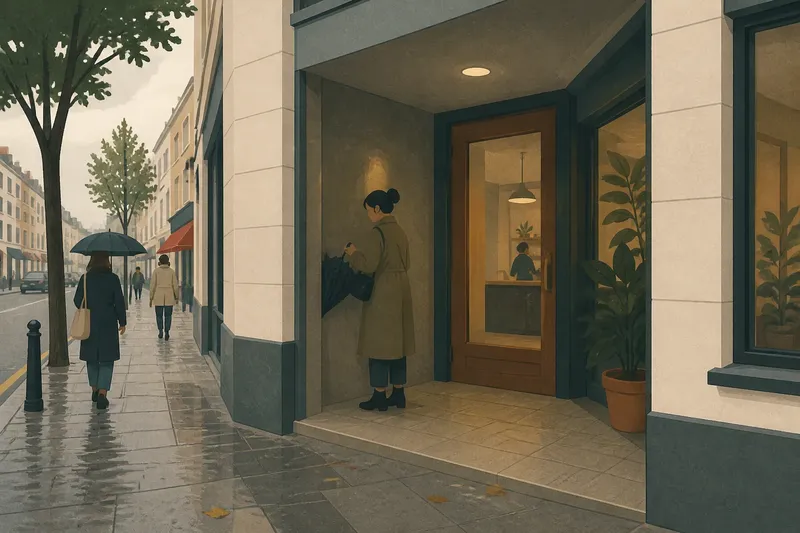
The common mistake is to treat a doorway set back from the pavement as wasted floor space. It costs a building a little frontage, but gives arriving people somewhere to pause without standing directly in the street or immediately entering the interior. That small interval can make the difference between crossing a threshold and simply passing through a hole in a wall.
Why do doorways step back?
A doorway steps back because the entrance is placed behind the building’s outer face, forming a shallow recess. The recess may be built into the façade, tucked beneath an arcade or created by a deeper entrance hall. In each case, the pavement continues into a small zone that belongs to neither street nor room entirely.
That zone has practical uses. Someone can stop to find a key, let another person pass or wait briefly out of the main pedestrian flow. A door that opens outwards has room to move without immediately occupying the pavement, though the actual arrangement depends on the door and the applicable building requirements. The recess can also offer shelter from wind or rain, depending on its depth, orientation and surrounding buildings.
There is a social use, too. A person can stand near the entrance and remain visible to people inside, while avoiding the feeling of being on display in the middle of the pavement. The setback softens the change from public street to private interior. It does not make the building private in any legal sense; it merely gives the transition a little physical shape.
How does a recess change arrival?
Arrival usually happens in stages, even when the distance is only a pace or two. A person approaches along the pavement, recognises the entrance, slows down, then crosses the threshold. A recess makes the slowing visible and gives it a place to happen. Without it, the first pause may take place in the pedestrian stream or just inside the door.
The change is subtle but legible. The façade acts as a frame around the entrance; the recess draws the eye towards the door and offers a brief sense of being sheltered from the open street. Once inside, the person has already crossed a small spatial boundary before reaching the main room. A shop, library or residential lobby can therefore feel less abrupt at the point of entry, even if the interior itself is plain.
Imagine a neighbourhood café with a door flush to the pavement and a narrow entrance recess beside it. A visitor arriving in the rain could step into the recess, fold an umbrella and let someone leave before opening the door. The observable difference is not a grand transformation: the visitor can complete those small actions outside the main walking line, and the café’s interior begins after a more deliberate threshold.
What makes a recess comfortable?
A useful recess is easy to recognise and does not feel like a leftover gap. Its proportions, lighting, surface and relationship to the pavement all matter. A deep, dim alcove may feel uncertain; a shallow one can provide little shelter and may leave a person awkwardly half in the street. The right balance depends on the building and its setting rather than a universal formula.
- Clear visibility: The door and the space immediately beyond it should be easy to see from the pavement. A person should not have to guess whether the recess is an entrance or a service gap.
- Legible flooring: A continuous, even surface helps the recess read as part of the approach. A sudden step, loose mat or confusing change in paving can make a brief pause less comfortable.
- Useful lighting: Light at the entrance helps people recognise the door and see who is approaching from inside. A bright patch surrounded by a dark recess can feel more theatrical than welcoming.
- Room to pass: The entrance should allow people to enter and leave without making the recess a pinch point. This matters especially where deliveries, prams or mobility aids are part of ordinary use.
- A clear edge: A canopy, side wall or change in material can mark the sheltered zone without turning it into an obstacle. The entrance should still read as part of the street frontage.
- Weather awareness: The direction of prevailing rain and wind affects whether the recess offers meaningful shelter. A setback facing directly into the weather may provide less comfort than its appearance suggests.
These are observations for reading or discussing an entrance, not instructions for altering one. Where a design decision depends on product instructions, building requirements or local rules, those sources determine the appropriate answer.
Is a recessed entrance always better?
No. A recess can make arrival easier, but it can also conceal the entrance, interrupt a narrow pavement or create an unwelcoming pocket. Its value depends on how the building meets the street and how people use the entrance throughout the day.
A small shop may benefit from a visible doorway that opens directly onto a generous pavement, especially if the frontage needs to display goods or keep the entrance easy to find. A larger public building may have more reason to provide a sheltered waiting place. Neither arrangement is automatically more sociable. A recess that obstructs movement or remains poorly lit has not improved the street merely by being set back.
There is also a distinction between a threshold and a barrier. A recess should give a person a moment to adjust, not make them feel they must ask permission to enter. High walls, opaque doors or an entrance hidden around a corner can turn a small pause into uncertainty. The most inviting examples make the door visible while still giving the approach some depth.
What do people ask about recessed doors?
Does a recessed doorway provide shelter from rain?
It can, if the recess and the building’s orientation keep rain from reaching the entrance. Wind-driven rain may still blow into it, so the depth alone does not tell the whole story.
Can a recess make a building feel more welcoming?
It can give visitors a place to pause and make the entrance feel distinct from the pavement. If the doorway is hard to see or the alcove feels dark, the same setback may instead make arrival uncertain.
Why are some entrances flush with the façade?
A flush entrance can suit a narrow site, a busy frontage or a design that prioritises a direct connection to the pavement. It may also reflect constraints of the existing building rather than a deliberate preference for a brisker arrival.
Is the space inside the recess public?
Not necessarily. A recess may feel open to passers-by while still forming part of a privately owned building or a controlled entrance area. Its ownership and permitted use depend on the particular property and local arrangements.
What is not worth overthinking?
There is little value in judging a doorway by the recess alone, or in expecting a small setback to solve every problem of access, shelter or welcome. Notice whether the entrance is visible, whether a person can pause without blocking others and whether the threshold feels clear. Those ordinary details say more than the mere fact that the wall steps back.
A recessed entrance works best as a modest piece of street etiquette built into the building: a place to hesitate, make room and enter at one’s own pace. The next time a doorway sits behind the pavement line, look at what people do there. If they can pause without having to choose between the street and the interior, the building has made its threshold useful.