Landmark or Street Sign: Two Ways to Give Directions
Landmark or street sign directions work best in different situations; learn how to combine both so a route stays clear when buildings or names fail.
The common mistake in giving directions is choosing either landmarks or street names and assuming the other person sees the same route you do. Landmark or street sign directions each solve part of the problem; relying on only one can leave someone unsure at a junction, or confidently walking past the right turn.
A street name gives a route a stable, shared label, provided the sign is visible and the traveller knows where to look. A landmark makes instructions easier to picture, provided it is recognisable and still there. Good directions use each for the job it does best, then account for the places where both can let someone down.
When names go missing
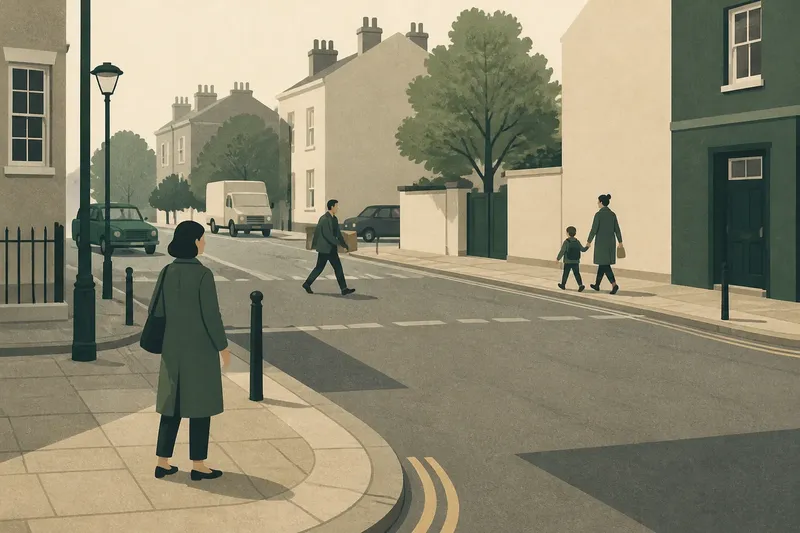
Street-name directions often fail at the point where a person needs the name most: the turn. Signs may be fixed to a wall set back from the corner, obscured by a tree, placed on the far side of a broad junction or angled towards traffic rather than pedestrians. In older streets, one road may also have a different name on each side of a boundary.
The cause is usually a mismatch between the route as described and the route as seen from the pavement. “Turn right into King Street” is concise, but it assumes that King Street is labelled at the entrance and that the traveller can identify which right-hand opening counts. At a busy junction with several side streets, that is a poor assumption dressed as brevity.
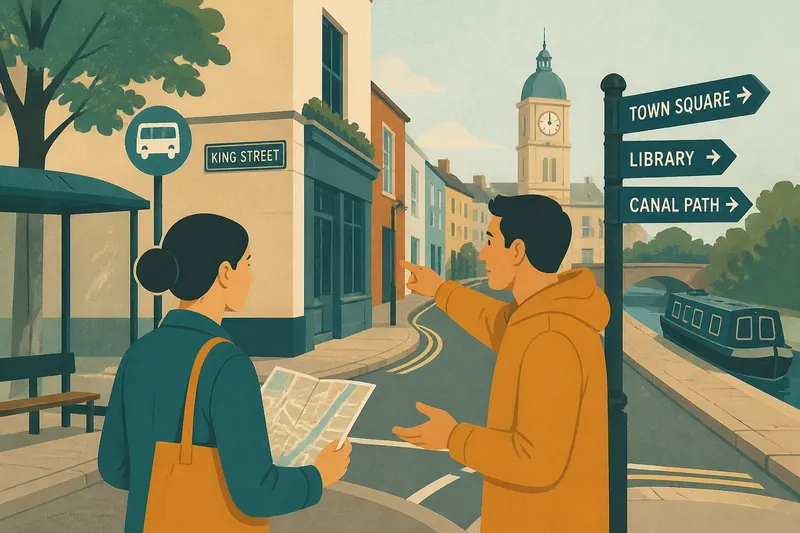
Try adding a visible approach cue before the street name: “At the bus stop, turn right into King Street.” If the sign is likely to be difficult to spot, give the next confirmation point too: “Stay on King Street until it meets the canal path.” The street name still carries the route’s structure; the bus stop and canal path help the traveller match that structure to the scene.
When landmarks mislead
Landmark directions can be easy to remember and hard to follow. A landmark may be hidden by parked vehicles, changed by building work or confused with a similar-looking shop. “Go past the church” is less useful if the church sits beside the junction rather than beyond it, or if there are two churches within walking distance.
Vague landmarks also invite different interpretations. A person who hears “the big red building” may choose the one visible from the approach, while the speaker means the one around the corner. The issue is not that landmarks are informal; it is that a description can identify an object without explaining its position in the route.
Name the landmark’s role as well as its appearance: “Turn left just after the post office” or “Cross the square towards the library entrance.” If the object is temporary or likely to change, pair it with a street name or another lasting feature. A café can help locate a turn today; the street name gives the traveller a way to check that the intended route continues beyond it.
When the route has several turns
A chain of street names can become a memory test. Someone may remember the first road and the destination, then lose the middle of the sequence while negotiating traffic, looking at signs or keeping a conversation going. A chain of landmarks can be just as fragile: each object has to be noticed in order, and one missed cue leaves the next instruction floating.
Break a complicated route into short sections, each with a decision and a confirmation. A decision tells the traveller what to do at a junction; a confirmation tells them they have done it. For example: “Take the second left into Mill Lane. Continue until you reach the clock outside the station; the entrance is opposite.” The street name distinguishes the turn, and the clock gives a recognisable check before the destination.
Do not add every detail you can see. Too many landmarks compete with the important one, while a long list of street names is difficult to retain. Choose the cue that helps with the next decision and the one that confirms the direction afterwards. If the route is simple, one of each may be unnecessary; directions should fit the route rather than demonstrate how many local names the speaker knows.
When names are unfamiliar
A street name may be precise yet unhelpful to someone who has never heard it. Unfamiliar names are easy to mishear, especially where several nearby roads have similar endings or spellings. A traveller can also reach the correct street and still be unsure whether to turn at its beginning, cross it or follow it for a while.
Say the name clearly, then attach an observable cue: “Follow Ash Grove past the playground entrance, then take the next right.” If the person is using a map, the name helps them check the route; if they are looking up from the screen, the playground entrance gives them something to recognise. For a name that is difficult to say, spelling it can help, but spelling is not a substitute for describing the junction.
Landmarks can also be unfamiliar in a cultural or personal sense. A building that locals call “the old market” may mean nothing to a visitor, and an informal nickname may not appear on a map. Describe the object in plain terms as well as naming it: “the covered market with the glass roof” gives the traveller another route into recognition.
When the landmark changes?
What if a shop has closed?
Use a lasting feature beside it, such as the street name, a public building or the shape of the junction. If the shop is the only cue, give a second description of the turn that does not depend on its sign.
Should I use a map or a landmark?
Use the map to confirm the sequence of roads and the landmark to identify a decision point in the street. Neither needs to replace the other; a map can show where a street runs without making its entrance obvious at pavement level.
What if there are two similar landmarks?
Distinguish the one you mean by its position or feature: “the library on the square, not the branch beside the station.” If that description still leaves room for doubt, give the street name and the direction of travel as well.
How many cues should directions include?
Include enough to identify the turn and confirm that the traveller is on the right route, then stop. A cue for every doorway and shop window adds detail without necessarily adding clarity.
When the listener needs to ask
People do not always share the same starting point. “Turn left at the crossing” may describe the speaker’s approach, not the listener’s; “go towards the station” may be unclear if the station is visible in more than one direction. A direction that depends on orientation should state the approach: “With the station behind you, turn right into Market Street.”
Give the traveller room to check rather than treating a question as evidence that the directions failed. If they ask whether they have passed the right turn, answer with a cue they can see from where they are: a road name, a junction shape or a recognisable public building. Repeating the original instruction more loudly is a traditional response, and not a particularly useful one.
Say you are directing a visitor from a library to a community hall on a route with two possible left turns. “Go left after the library” is ambiguous if the library has more than one exit. A clearer instruction would identify the starting point and the turn: “Leave by the entrance facing Rowan Street, then take the second left. Continue to the green railings; the hall entrance is beside them.” The named street establishes the approach, while the railings confirm the final stretch. This invented situation works because each cue answers a different question, not because it supplies more words.
Choosing the right balance
For a route through a regular grid with clear signs, street names can do most of the work. For an irregular square, a market frontage or a large junction where the sign is hard to see, a landmark may be the more useful first cue. For unfamiliar districts, changing shopfronts or several similar buildings, combine a street name with a lasting feature and a clear instruction about what to do at it.
Landmark or street sign directions are not rival systems. One tells a person which named route to follow; the other helps them recognise where to act. Before giving directions, consider what the traveller will see from the approach, whether the cue is distinctive and whether it is likely to remain. It is not worth memorising every shop name along a route or inventing a landmark for every junction. One well-chosen cue beats a guided tour of the pavement.
When you are unsure, give the street name, describe the turn in relation to the traveller’s approach, and add one visible confirmation point. That small combination is easier to follow than a perfect list of names or a local’s private catalogue of familiar buildings.